 By Admin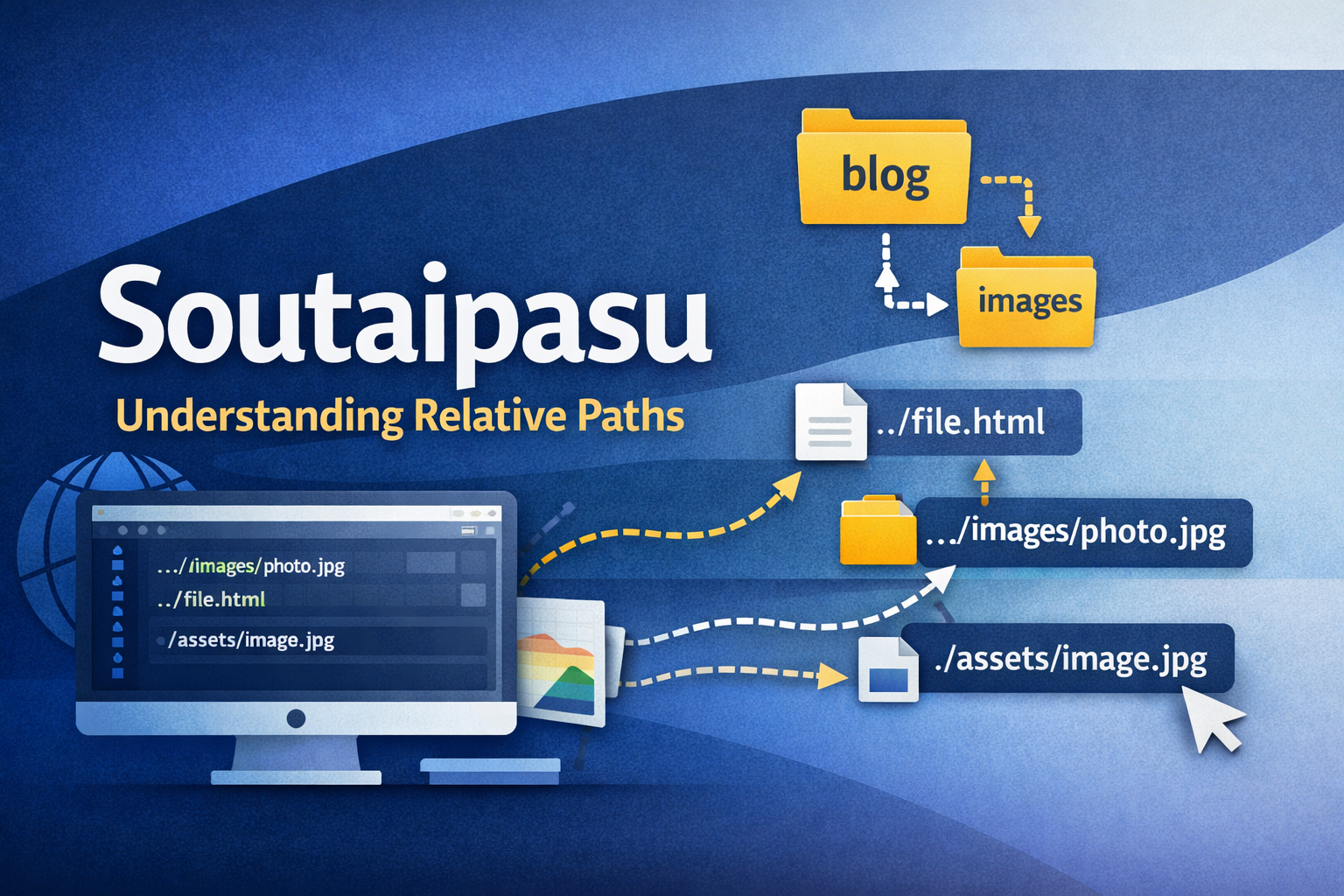
If you searched for Soutaipasu, here’s the clearest answer: the keyword appears to map to the Japanese computing term 相対パス, which means relative path in English. In simple words, a relative path tells a computer or browser where a file is based on your current location, not from the full root address. Authoritative documentation describes a relative path exactly this way—something written from the current directory or base URL rather than as a full absolute path.
What Soutaipasu Actually Means
A relative path is a shorter, context-based way to point to a file, folder, or URL. Instead of writing the entire address, you write the route from where you are now. Oracle’s documentation explains that relative paths show the relation between the current working directory and the target file or folder. Microsoft and MDN also describe relative references as paths resolved from a base location.
That’s why Soutaipasu matters. It’s not just a weird keyword. It’s a real idea used in web development, programming, operating systems, and file management every day. And yes… beginners often run into it without realizing what it’s called.
How Soutaipasu Works
Think of it like giving directions from where you’re standing.
If you are inside a folder called blog and want to open an image in an images folder next to it, you might use a path like ../images/photo.jpg. MDN explains that ../ moves up to the parent directory, while relative references are resolved from the current directory of the base URL. Oracle gives the same idea for file systems: you move from your present directory to the target without writing the whole root path.
Here are the most common relative path pieces:
./= current folder../= one folder up../../= two folders upfile.html= a file in the current folder/path/file.html= root-relative on a website, based on the site root rather than the current page path
Soutaipasu vs Absolute Path
This is where people get confused, so let’s make it easy.
| Path Type | What It Means | Example |
|---|---|---|
| Relative Path | Starts from your current location | ../images/logo.png |
| Absolute Path | Starts from the root or full location | https://example.com/images/logo.png or /home/user/images/logo.png |
| Root-Relative Path | Starts from website root | /images/logo.png |
Authoritative references distinguish these clearly: relative paths depend on the current location, while absolute paths point from the full root. On the web, MDN notes that paths beginning with / are resolved from the site root.
Why Soutaipasu Is Important
Relative paths are popular because they’re practical.
- They make links shorter
- They help when moving a project between folders or servers
- They keep internal website files easier to manage
- They reduce the need to rewrite every full URL during development
- They work well when a document has a clear base location
And there’s another reason. In web development, browsers resolve many links, scripts, images, and stylesheets using a base URL. MDN explains that the <base> element can even change how all relative URLs in a document are interpreted. So one small path can affect a lot more than one file.
Common Mistakes with Soutaipasu
But relative paths are not perfect.
A small mistake can break images, links, downloads, or scripts. Using too many ../ segments can also create security problems. Japan’s IPA warns that relative path notation can be abused in directory traversal attacks, where someone tries to access files the site owner never meant to expose.
Watch out for these problems:
- Wrong folder level
- Mixing root-relative and page-relative paths
- Forgetting the current base location
- Broken links after moving files
- Unsafe path handling in apps or uploads
Final Thoughts
So, Soutaipasu is best understood as relative path—a simple but powerful way to point to files based on where you are now. It’s a core concept in coding, websites, and digital file systems. Not flashy. But very useful.
And once you understand it, a lot of “why is this file not loading?” problems suddenly make sense.